


Today, September 9, 2025, the National Assessment of Educational Progress (NAEP), often called the “Nation’s Report Card”, released its latest results for 12th-grade students in reading and math, and for 8th-grade students in science. The findings are not just disappointing, they are alarming. Scores have dropped across the board, and the achievement gap is widening. This isn’t just a data point, it’s a national emergency that demands immediate action.
Math: A Widening Gap in Foundational Skills
The average math score for 12th graders dropped 3 points compared to both 2019 and 2005. Scores declined across all percentiles except the 90th, meaning that while top performers held steady, lower-performing students fell further behind. Fewer students reached “NAEP Proficient,” and more dropped below “NAEP Basic”—the lowest achievement category.
These results reflect a troubling erosion of core math skills. Students are struggling with probability, data analysis, and basic problem-solving. At a time when STEM careers are booming, our students are being left behind.

Reading: The Sharpest Decline Since 1992
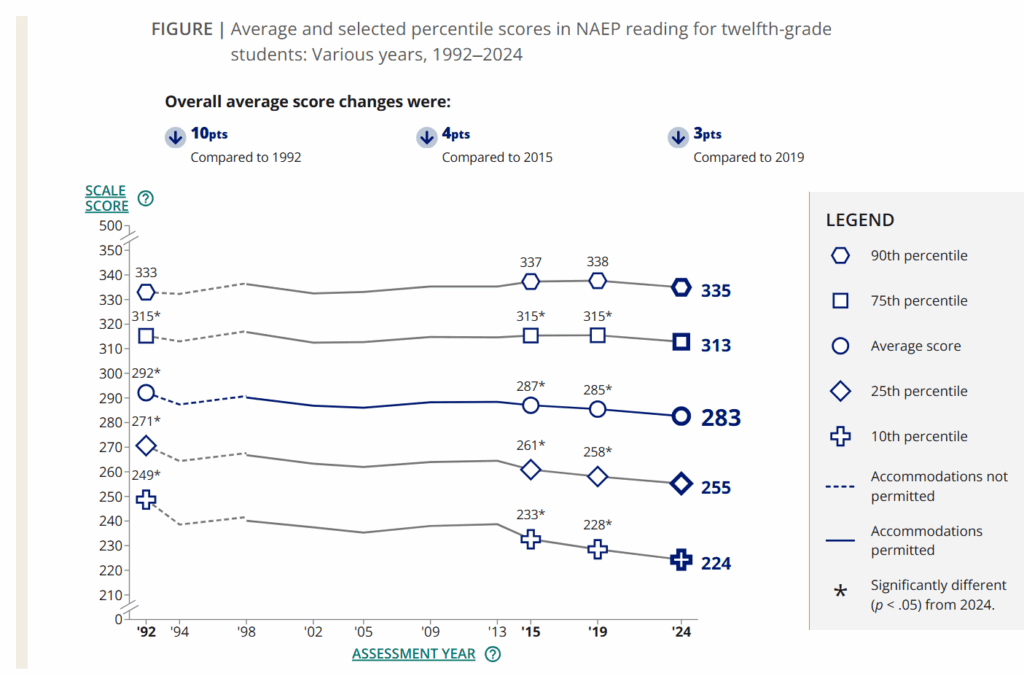
Reading scores for 12th graders fell 3 points since 2019 and a staggering 10 points since 1992—the first year the assessment was administered. This marks the lowest reading performance ever recorded. Scores dropped across all percentiles except the 90th, and female students saw significant declines at both the 25th and 75th percentiles.
Students today are less able to comprehend complex texts, infer meaning, and evaluate arguments. This isn’t just an academic issue; it’s a civic one. Reading is the foundation of informed citizenship, and we are watching that foundation crumble.
Science: Confidence and Competence in Freefall
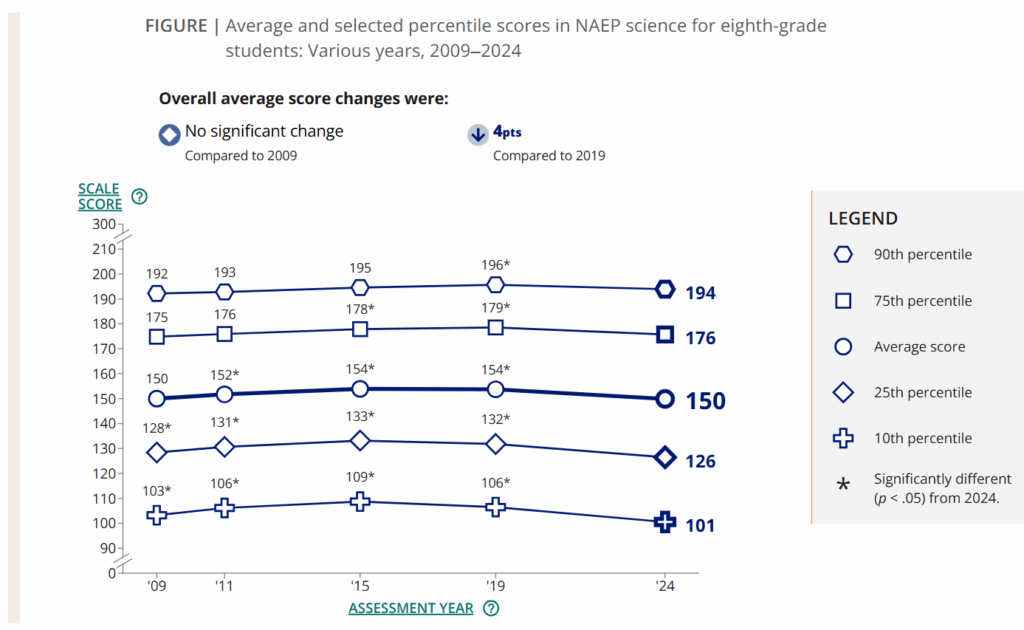
Among 8th graders, the average science score dropped 4 points compared to 2019. Scores declined in all three content areas, Physical Science, Life Science, and Earth & Space Sciences, and across all performance levels. The percentage of students scoring below “NAEP Basic” rose to 38%, the highest since 2009.
Even more troubling, students reported lower confidence in their science knowledge and skills. They’re not just performing worse—they’re feeling defeated. That’s a dangerous combination in a world increasingly shaped by scientific and technological innovation.
The Screen Time Effect: A Silent Saboteur
One factor that cannot be ignored is the impact of excessive screen time. Students today are spending more hours than ever on phones, tablets, and computers—often consuming short-form content that undermines attention span and deep thinking.
Reading habits have shifted dramatically. Fewer students are reading full-length books, and more are engaging with snippets, summaries, and social media posts. This shift has real consequences. The NAEP reading assessment requires interpretive and critical thinking skills—skills that are dulled by constant digital distraction.
In math and science, screen time competes with hands-on learning and problem-solving. The decline in scores suggests that passive consumption is replacing active engagement. We must ask: Are we raising a generation of scrollers instead of thinkers?
Absenteeism: The Hidden Crisis
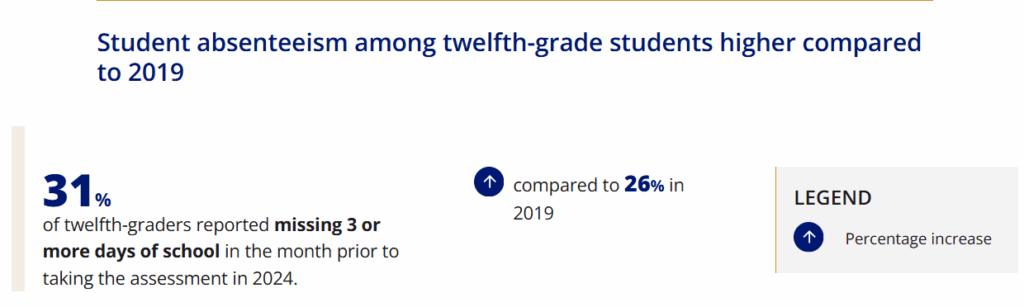
Absenteeism has surged. In 2024, nearly one-third of 12th graders reported missing three or more days of school in the month leading up to the assessment. That’s a sharp increase from 25% in 2019.
This matters. Students who aren’t in school aren’t learning. Chronic absenteeism disrupts continuity, weakens relationships with teachers, and erodes academic progress. It’s a symptom of a deeper disengagement—and it’s hitting our most vulnerable students hardest.
Reform the System, But Save the Children Now
At Conservative Ladies of America, we believe in the promise of public education—but we also believe in truth. The system is broken. And while we work to fix it, our children cannot wait.
We must pursue a dual mandate:
1. Immediate Action
- Support and expand alternative education options:
- Homeschooling
- Microschools
- Charter programs
- Private education
- Parents need choices now—not after another decade of decline.
2. Long-Term Reform
- Overhaul public education with a renewed focus on:
- Academic excellence
- Accountability
- Parental rights
- Restore rigorous standards and meaningful assessments.
This is not about abandoning public education—it’s about refusing to abandon our children while the system catches up.
Call to Action
- Parents: Explore alternative education options. Your child’s future depends on it.
- Policymakers: Prioritize student outcomes over bureaucracy.
- Citizens: Join CLA in advocating for educational freedom and excellence.
The numbers are clear. The crisis is real. And the time to act is now.
Support the Mission
CLA is fighting to protect our children and reform education. Your donation helps us expand alternatives, empower parents, and advocate for real change. Donate now and stand with us!